


Mordor Intelligence has published a new report on Infant Nutrition Market offering a comprehensive analysis of trends, growth drivers, and future projections.
Introduction
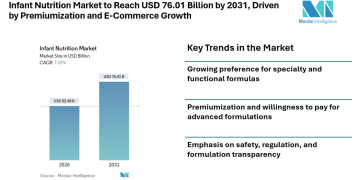
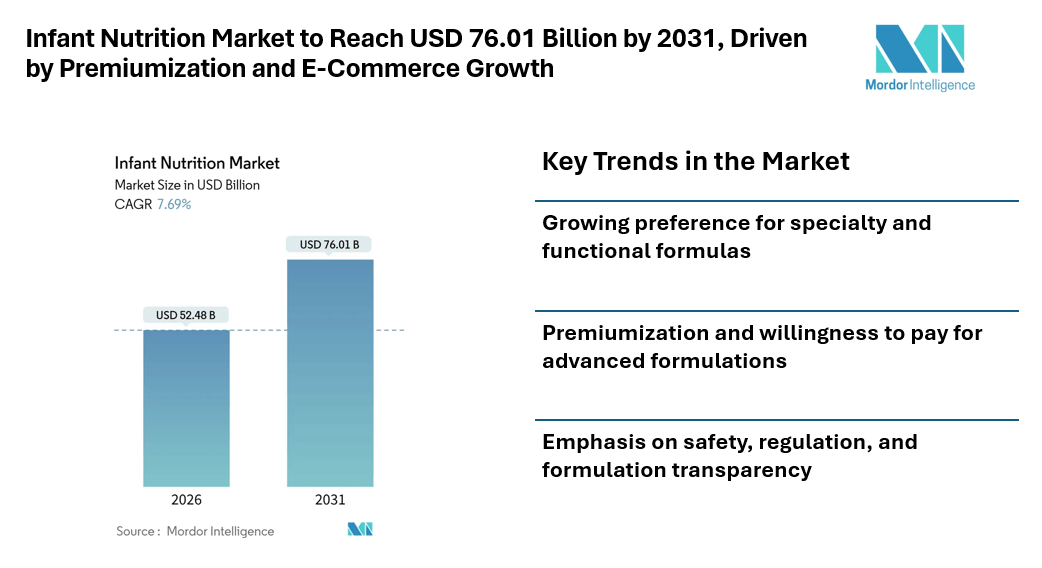
The infant nutrition market size is currently valued at around USD 52.48 billion in 2026 and is projected to grow to approximately USD 76.01 billion by 2031. This represents a compound annual growth rate (CAGR) of about 7.69% over the forecast period.
As modern lifestyles shift and parents increasingly emphasize scientifically backed nutrition for infants, the infant nutrition market is gaining momentum. The demand is being shaped by rising numbers of dual-income households, parents’ willingness to invest more in infant health, and the growing reach of digital sales channels.
This press release provides insights into the key trends, market segmentation, major players, and outlook for the infant nutrition market, with optimized focus on keywords such as infant nutrition market, infant nutrition market share, infant nutrition market size, infant nutrition market trends, infant nutrition market analysis, and infant nutrition market growth.
Key Trends in the Infant Nutrition Market
Growing preference for specialty and functional formulas
Within the infant nutrition market, specialty formulas targeted products for infants with specific conditions such as allergies, prematurity, or metabolic needs are emerging as a fast-growing segment. Parents are increasingly opting for formulations enhanced with human milk oligosaccharides (HMOs), probiotics, and immune-supporting ingredients to support infant development.
Premiumisation and willingness to pay for advanced formulations
As household incomes rise, especially in developing and emerging markets, there is a shift from basic to premium infant nutrition offerings. Many parents are prioritizing nutritional efficacy and formulation transparency over cost, driving growth in higher-margin products.
E-commerce and direct-to-consumer models gaining traction
E-commerce channels, including D2C subscriptions and online retail, are recording the fastest growth among distribution modes. Convenience, better product availability, and direct engagement with consumers have made these channels increasingly important in the infant nutrition market.
Emphasis on safety, regulation, and formulation transparency
Given the sensitivity of infant products, stricter regulations and consumer awareness push manufacturers to adopt more transparent labeling, rigorous quality assurance, and safer ingredients. Litigation risk for example related to necrotizing enterocolitis (NEC) is pushing companies to reinforce safety credentials and clear communication in their offerings.
These trends are foundational to how the infant nutrition market will develop in the coming years and are central to the infant nutrition market analysis.
Check out more details and stay updated with the latest industry trends, including the Japanese version for localized insights: https://www.mordorintelligence.com/industry-reports/infant-nutrition-market?utm_source=emailwire
Market Segmentation of the Infant Nutrition Market
The infant nutrition market is divided across multiple axes product, form, ingredient, distribution channel, and geography. Below is a breakdown:
By Product
- Infant Formula (standard formula)
- Specialty Formula (e.g. hypoallergenic, metabolic, preterm)
- Baby Food (complementary feeding products)
By Form
By Ingredient / Source
- Cow-milk based formulations (largest share)
- Functional / Fortified ingredients (e.g., HMOs, probiotics)
By Distribution Channel
- Hypermarkets & Supermarkets (largest share)
- E-commerce / Direct-to-Consumer (fastest growth)
- Other channels (e.g. specialty retailers)
By Geography
Key Players in the Infant Nutrition Market
The infant nutrition market features a mix of global multinationals and regional specialists. These players compete across formulation, R&D, branding, and distribution strength. Some of the major players active in this space include:
- Danone / Danone Nutricia
These firms frequently invest in research on novel ingredients (such as HMOs, probiotics, and bioactive compounds), improve supply chain transparency, and expand their presence via digital channels or acquisitions. Their scale allows them to enter markets with rigorous regulation, and their brand equity often helps with consumer trust in sensitive infant products.
In many markets, local or regional brands also play a meaningful role especially where distribution or regulatory challenges favor companies with local presence or tailored formulations.
Conclusion
The infant nutrition market analysis makes clear that while powder formulas and hypermarket channels still dominate in share, the fastest expansion is occurring in functional, convenient, and digitally sold formats.
As competition intensifies, success in this space will hinge on aligning with consumer demands for transparency, health value, and accessibility. The report from Mordor Intelligence provides a comprehensive foundation for stakeholders to navigate this evolving landscape and capture opportunities in the evolving infant nutrition market.
For complete market analysis, please visit the Mordor Intelligence page: https://www.mordorintelligence.com/industry-reports/infant-nutrition-market?utm_source=emailwire
Industry related Reports:
Clinical Nutrition Market: The Clinical Nutrition Market is Segmented by Route of Administration (Oral and Enteral, and More), Product Type (Infant Nutrition, and More), Form (Powder and More), Application (Nutritional Support for Malnutrition, and More), by End User (Pediatric, and More), Distribution Channel (Hospital Pharmacies, and More), and Geography (North America, Europe, and More).
Enteral Feeding Formulas Market: The Enteral Feeding Formulas Market Report is Segmented by Product Type (Standard Polymeric, High-Protein Polymeric, Peptide-Based, Elemental, Disease-Specific, and More), Caloric Density (Low Energy, Isocaloric, and More), End-User (Hospitals, Long-Term Care, and More), Age Group (Neonates, Pediatrics, and More), and Geography (North America, Europe, and More).
Parenteral Nutrition Market: The Parenteral Nutrition Market is Segmented by Nutrition Type (Carbohydrates, Parenteral Lipid Emulsion, Single Dose Amino Acid Solution, and More), Patient Type (Neonates, Pediatrics, and More), End-User (Hospitals, Clinics, Homecare, and Others) and Geography (North America, Europe, Asia-Pacific, and More).
About Mordor Intelligence:
Mordor Intelligence is a trusted partner for businesses seeking comprehensive and actionable market intelligence. Our global reach, expert team, and tailored solutions empower organizations and individuals to make informed decisions, navigate complex markets, and achieve their strategic goals.
With a team of over 550 domain experts and on-ground specialists spanning 150+ countries, Mordor Intelligence possesses a unique understanding of the global business landscape. This expertise translates into comprehensive syndicated and custom research reports covering a wide spectrum of industries, including aerospace & defense, agriculture, animal nutrition and wellness, automation, automotive, chemicals & materials, consumer goods & services, electronics, energy & power, financial services, food & beverages, healthcare, hospitality & tourism, information & communications technology, investment opportunities, and logistics.
For any inquiries or to access the full report, please contact:
media@mordorintelligence.com
https://www.mordorintelligence.com/